
Revised December 2011.
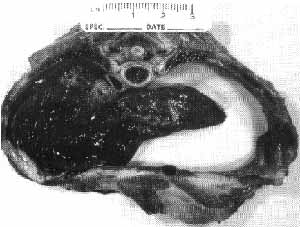
An infrequent, puzzling phenomenon is the litter in which many, if not all, of the whelps become strangely deformed sometime in the first two weeks of life. A flattening of the thorax and abdomen, top to bottom, becomes evident about a week after birth from some unknown cause. It apparently happens most often in the dwarf (chondrodystrophic) breeds but has been seen in the German Shepherd Dog and other breeds. Instead of the thorax developing normally into a progressively deeper tube from the prosternum/neck area to the diaphragm, it forms more of a flattened cylinder with the height from floor to spine about the same all the way back to the loins, and perhaps even lower midway down the back. The forechest, instead of dropping from the prosternum to the last sternal vertebra, may even be concave, and as time goes on the puppy becomes even more pancake shaped.
As the ribs bow out, the heart and other organs may be pushed into the pleural cavity and displace or decrease the air volume of the lungs; as a result, untreated pups become lethargic, lacking in energy and strength. By the third to fourth week, when normal pups would be running around, affected pups have not yet learned to push themselves up into a standing position. If the extended limbs, especially front legs, are moved at all, it is with a paddling motion to the sides, hence the disorder is called “Swimming-Puppy Syndrome.” The hind legs typically are extremely weak; they may be tucked under the torso, or less frequently extend behind the pup, but in either case they have little or no movement. “Swimmers” have very poor circulation, respiration, and ability to swallow food or keep milk in their stomachs, and as they are old enough to wean, are very slow when eating from pans. Stifles may be rotated underneath the belly, patellas are often luxated, and other orthopedic or osteochondral defects may be noted. Many die from inhalation pneumonia (from inspiring regurgitated milk) or other forms of respiratory failure.
If swimmers are not given some sort of therapy, there is a less than even chance they will survive to eight weeks. Generally, those that do manage to live, only begin to walk at or after this age. A 1981 Veterinary Medicine/Small Animal Clinician report on a litter of Shepherd pups, five out of six of whom were swimmers, mentions one pup that started walking by nine weeks old, but by six months was still unsteady and slightly undersized (female, 40 pounds). Because she tired rapidly, even after only moderate exercise, she was euthanized. Autopsy showed that her vertebral/rib joints were enlarged, but internal organs seemed normal in appearance. Based on this sort of evidence it’s possible to conclude that there might be another cause for her weakness other than ventro dorsal compression. There may also be permanent damage from the compression early in life that affects viability later, even if therapy seems to have helped. There may be variability in the severity, based on genetic or environmental factors, or a combination of these. Many factors have been accused of contributing to the syndrome, both environmental and some of unknown genetic origin. For a while, most people blamed slippery floors, but I’ve raised all my litters on smooth, impervious flooring covered with newspaper and have never had a swimmer in my own operation. The VM/SAC report mentioned above involved excellent footing in the whelping/nursing box: clean, dry, rough surfaced indoor/outdoor carpeting. Until this report, it was generally believed that such a floor would prevent swimmers from developing. I disagree, especially with the use of carpeting, as this surface is notorious for harboring germs. Newspapers are best for lining the nest or exploration areas of the house that has new pups, through the time they are housebroken.
Some Dachshund breeders told me they were fairly successful in correcting the syndrome by putting each of the pups in a sling for at least part of each day. This practice encouraged them to make contact with the floor with their pads. Some tied hobbles to the front legs to keep them under the body and the elbows close together. This, they felt, prevented the front legs from becoming spread-eagled. Dish shaped nests of straw have also been suggested, but not only does that present the danger of filthy conditions, it isn’t practical. A modification of the idea has also been proposed: put the whole whelping/nursing area into a sling thus making the “floor” more like a hammock with the canvas or vinyl suspended at the corners and edges and lower in the center. I doubt the efficacy of any of these, but as sailors used to say, “Any port in a storm.” 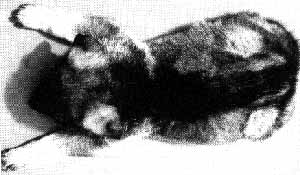
Another therapy that may be beneficial, although tiresome and time demanding of the breeder, includes massage (passive exercise), administration of vitamin E (with selenium added if they’re not getting solid food yet; but have your vet advise, as it’s easy to overdose selenium, which is then toxic), taping hobbles to prevent splaying, and suspension in warm water. The last-named is possibly the most promising if either active or passive movement can be induced. Thus, swimming (the real kind, in water) may help correct the swimming syndrome. Whirlpool baths are beneficial for partially paralyzed or weak adults such as those suffering from coonhound paralysis, but of course the waves in such a tub would overwhelm a 3 to 6 week old puppy. Therefore, hold him in your hand or a sling, with support to keep his head up out of the water, and let him paddle for a while in warm water (probably around 75 to 80 degrees F to prevent chilling), but take him out and dry him thoroughly if he tires. As many of these sessions as you can manage should help the pup to develop coordination, muscle development, and better circulation while putting much less weight on his body. Your hand or makeshift sling plus the buoyancy of the water will take the weight off the chest. Finger manipulation of his limbs would be a good idea, too, while he’s in the water, but also when he’s out.
In 1999, after the above was printed in my book “The Total German Shepherd Dog,” 2nd edition, published by Hoflin, some e-mail correspondence on the subject came to me. A French Bulldog breeder expressed the belief that a dam that produced this defect should not be spayed! She promulgated these dangerous ideas on the Internet, both on her website and “chat rooms” where many can add their own, frequently unscientific, comments.
She had two swimmers, each 12 oz at birth, never left on flat surface; she said she put them on blankets, “facing upwards and they stayed in a upright position,” and claimed they were both fine within weeks. The syndrome of swimmer puppies is sometimes referred to as Pectus Excavatum, and described by her as “a condition of ‘so called’ flat chested puppies.” Without intervention, and often despite efforts, they usually die anywhere from two days to four weeks of age. Sooner more often than later, according to the Bulldog people I heard from. When nursing (if it is able to get to the treat at all), the puppy may arch its back extremely in a backward movement to compensate for an apparent inability to flex at the neck.
Some breeders prefer not to assign blame to genetics. They disagree with those of us who hold that the puppy inherited the problem from the parents, and a pair that produces a swimmer puppy should be removed from one’s breeding program. These people postulate that the bitch was fed inadequately or that she did not utilize the necessary dietary nutrients (i.e., vitamins, proteins, fats, or minerals) to give the puppy the “skeletal components needed.” This is really stretching credulity beyond all limits, as swimmers also happen in households of experienced breeders, and to bitches whose diets are normal. In this age of commercial dog food, it is nearly impossible to blame it on such a drastic dietary deficiency. Others who refuse to acknowledge the major part that genes play in determining characteristics and deformities tend to blame environments such as “too flat a surface, too hard a surface, too slick a surface, bacteria, viruses,” etc.
A woman who raised Lhasa Apsos and American Cocker Spaniels made some very interesting observations that may give us a clue to the primary genetic defect: She had become frustrated with the feeble answers from “experts such as vets and breeders [who]… all knew what it was and all had answers, none of which were very successful… None of which had real solutions.” She started to see a pattern emerge. The incidence of swimmers appeared to be “random.” Type of food or use of supplements “didn’t decrease or increase the occurrence of swimmers.” What she did observe was that “the syndrome began to show up at anywhere from one hour to a couple of days after birth, beginning with a slight flattening of the chest or an actual bend in the ribs.” I believe that by careful observation, she hit upon a method of early identification of afflicted pups and therefore carriers of the defect. By following her techniques, one may prevent the development of the symptoms, but will not eliminate the genes that cause the untreated pup to become a swimmer. I am enough of a eugenicist to want to remove such carriers from the gene pool, but enough of a “compassionate conservative” (as a famous politician’s speech writer coined the term) to want to save any pup that could possibly live a useful life and bring someone happiness. However, such pups, while saved from death or painful existence, should be neutered.
The Lhasa and Cocker lady became adept at determining if a pup has a problem by picking up each pup and testing its “righting reflex.” She correctly stated, “What you will notice about these [affected] pups is that they are always lying flat on the belly. If you lay them on their side, they will immediately return to lying on their bellies. This is what is known as the righting reflex. You can observe this by disturbing a sleeping litter of very young puppies and watching all of them ‘right’ themselves. They immediately crawl to [lie on] their stomachs and begin to look for a nipple. The righting reflex is the first response to nursing and the cause of swimmer puppies.” While that last phrase may sound a bit awkward, it is true that the normal neonate has an instinct to get onto its belly and drag itself to a teat. Once there, it may just as easily and happily flop over on its side a little, as long as it does not twist too far in the direction of having its belly side up. After nursing, the normal newborn pup will lie on its side to sleep. As they get a little older, they will be just as comfortable draped over each other, and as they are old enough for the ribcage to have developed strength, they may sleep belly-down for a while, but by then it is not abnormal.
Occasionally a puppy seems to indicate that it “doesn’t want to” or cannot “return to a normal relaxed state on its side and insists or remains [on its belly] causing the flattening of the chest, which, if left undisturbed, leads to swimmer syndrome and probable death.” This is not a defect in the righting reflex, per se, but a genetic defect in proprioception, the instinctive knowledge of position. It may well originate in a genetic defect in the embryonic development of the inner ear. Perhaps the swimmer has inherited poor proprioception and therefore its body “doesn’t know to roll over on its side”; once in the righted position used for finding the nipple, it has no way of knowing that there is a more comfortable and normal resting position.
The ear is divided into three parts: outer, middle, and inner. The outer part helps funnel sound to the eardrum, a membrane on the other side of which is the middle ear. There, three bones hinged together relay eardrum vibrations to the inner ear, which is separated by more membranous tissue. The inner ear includes not only the nerve endings that transform mechanical movement into electrical impulses and carry auditory messages to the brain, but it also includes the organ of balance. The rear part of the membranous labyrinth has three semicircular canals that look like three bicycle tubes joined together in one bulbous end. Each of the three canals is oriented 90 degrees to the other two, and all are filled with fluid and nerve endings. The tiniest movement of the body tells these moving-fluid-activated nerves what direction the head is turning, and thus informs the brain as to what muscles must contract in order to change or return to a given position. It is my hypothesis that in swimmers, somewhere along the chain of events the message is not being relayed or interpreted. We also see similar interruptions in these messages in older dogs, caused by infections, poisoning, or late-developing genetic factors.
The “cure,” if you want to call it that, will only be for the individual itself. If it is indeed a genetic problem, as I strongly suspect, correcting the condition in the individual does not erase the cause, so cannot be considered a cure in the strict semantic sense. If your breed has been know to have swimmers, or you are slightly paranoid by nature, steps to identify and correct must be taken as soon as possible and can be quite simple, Coreen says: “Check all the pups right after birth and every hour or so for the next couple of days. [I don’t know about you, but I have to sleep sometimes, and don’t have shift workers in my kennel to do this!] If you notice a pup that is always on its belly or beginning to show signs of a flat chest, what you do is lay mom down and put this pup on a good nipple. After it’s on, turn it on its side, holding its entire body and … making sure it stays on its side. If the pup lets loose… start over. Do this several times a day until the pup returns to normal and lays on its side; when that happens you have just cured swimmer puppy syndrome.”
You will have to determine for yourself if it is worth it, realizing that not everyone is able to save every defective puppy. And, you will want to prevent it from happening again, the surest and safest approach being not to breed either parent again. Play the odds: assume genetics unless you are absolutely convinced a problem is purely environmental. The longer I live, the more evidence I see that nearly everything has a bigger genetic component than you would initially think.
